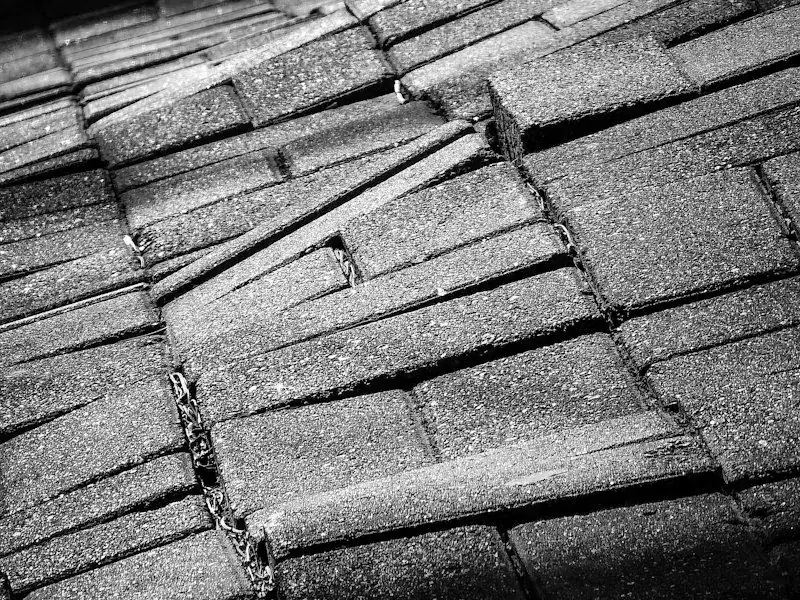
Asphalt shingle roofs stripped and rebuilt, with the layer count established before the quote rather than discovered during it.
New Jersey allows no more than two applications of covering on a structure. Where two are already up there, a third is not an option and the tear-off is mandatory, which changes both the price and the programme. That is worth knowing before a quote is accepted, not after the first bundle comes off.
Most mid-job price changes on shingle work trace back to one thing: nobody established how many layers were up there before the number was written down.
Most mid-job price changes on shingle replacement trace back to one thing: nobody established what was already up there.
New Jersey permits no more than two applications of covering on a structure. Where two are up, a third is not available and the tear-off is mandatory rather than a preference.
Under two layers on an older building the sheathing may be plank rather than sheet, and it may have been wet for years. It cannot be assessed until it is exposed.
Northern New Jersey sits in the zone where it is required, running from the eave edge to at least 24 inches inside the interior wall line. On older roofs it is frequently absent.
Nail count and placement are specified for the wind the site actually sees. An exposed ridge or a waterfront street is not the same as a sheltered inner block.
An unvented deck runs hot and ages the covering from beneath. Two identical roofs, one vented and one not, do not last the same length of time.
On a constrained site the skip position and the number of loads shape the programme as much as the roofing does.
On a detached house the layer count can be checked properly at the eave and the rake before anything is quoted, which removes the commonest source of mid-job price change.
Lower density than the city at around six and a half thousand per square mile, with a stock of detached houses on established tree-lined streets.
Reference point: the township west of Irvington, on Newark's south-western side.
Detached period housing brings roof complexity back -- porches, dormers, bays and multiple planes. The porch roof is the usual weak point, tying into the main wall at a low pitch.
Larger detached houses often justify a better covering than the minimum, because the labour to fit it is the same and the access cost is already paid.
Lower density than the city at around six and a half thousand per square mile, with a stock of detached houses on established tree-lined streets.
All areas coveredWorth knowing before accepting any quote, because a scope that ignores these is a scope that will change later.
New Jersey adopts a single Uniform Construction Code and municipalities may not set lesser or greater technical requirements. A correct specification in Newark is correct in Kearny.
No more than two applications of covering may remain on a structure. A third means a full strip, whatever the quote assumed.
Replacing more than a quarter of a roof surface within any twelve months requires a construction permit. Splitting one job in two inside that window does not avoid it.
Required in this design zone, running from the eave edge to at least 24 inches inside the interior wall line.
In Newark the code is enforced by the city's Department of Engineering, Division of Construction Code Enforcement, which is where permits for qualifying work are issued.
Where a permit applies, the work is inspected at stages. A programme that ignores inspection windows is a programme that will slip.
The same job in the areas next door, and the other work we take on in this one.
See every area we do shingle roof replacement in across Newark →
General guidance about how these buildings are re-roofed, not a survey of any particular property.
Two. No more than two applications of covering may remain on a structure, so where two are already up there a third is not available and the tear-off is required rather than optional.
Largely, yes. On a detached building the eaves, rakes and valleys can all be reached and the layer count checked, which is why quotes on detached houses hold better than quotes on shared roofs.
Replacing more than a quarter of a roof surface within any twelve months requires a construction permit under the New Jersey Uniform Construction Code. A full replacement is over that threshold, so yes — and the work is inspected at stages.
Tell us what the building is and roughly how old the roof is. That is usually enough to say what the job involves before anyone goes up.