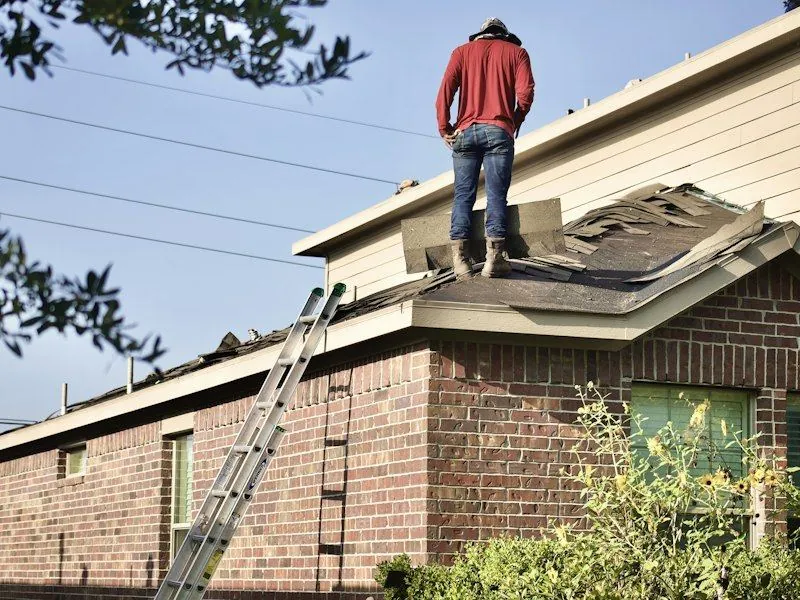
Replacement after a specific weather event, documented while the evidence is still on the roof.
Storm damage and ordinary wear are treated very differently, and the difference usually has to be demonstrated rather than asserted. What establishes it is a dated event paired with damage consistent with that event — lifted courses, displaced ridge, torn edge metal — not simply a leak noticed afterwards.
Two claims on the same street after the same storm can be judged very differently, and the difference is usually how well the damage was recorded in the first day or two.
Storm damage and ordinary wear are treated very differently, and the difference has to be shown rather than claimed.
A claim turns on a specific storm and on what that storm did locally. Tying the damage to a date is what separates sudden loss from gradual deterioration.
Temporary covering, debris clearing and the next rainfall each remove evidence. Photographs taken first are worth more than any description written later.
Lifted or displaced courses, torn edge metal, a moved ridge, impact marks. Wind damage is often visible only at the edges, which are the hardest parts to see from the ground.
Storm damage frequently sits on top of a covering already near the end of its life. An honest scope says which part is which rather than attributing everything to the weather.
Rebuilding exactly what failed reproduces the failure. Where the original fixing or edge detail was the weak point, the replacement is the moment to correct it.
A detached house can be photographed completely, from the ground and from ladder height, which produces far better evidence than a partial view of a shared roof.
Thirty thousand people on three and a third square miles, with a strong share of older detached and two-family housing on established tree-lined streets.
Reference point: the township north of Belleville on the Third River.
Mature street trees drive the outcome here. A new covering laid over drainage that cannot clear leaf load will fail early at the valleys, regardless of what it cost.
On a heavily treed street the gutter and valley detailing is worth more attention at replacement than the covering specification is.
Thirty thousand people on three and a third square miles, with a strong share of older detached and two-family housing on established tree-lined streets.
All areas coveredNewark sits in a humid subtropical shading into humid continental (Koppen Cfa/Dfa) zone with a full freeze-thaw winter — the combination hardest on flashings, fixings and mortar.
Water that gets into a lap, a joint or a hairline crack and then freezes expands. Northern New Jersey cycles through that repeatedly each winter, so small defects do not stay small.
Melt moves slowly under a snow layer and refreezes at the cold eave, backing water up under the covering where pitch does not help. That is what the ice barrier exists for.
Rain coming in sideways gets under laps that shed vertical rain perfectly well, which is why edge and flashing detail matters more than the covering specification.
The same job in the areas next door, and the other work we take on in this one.
See every area we do storm damage roof replacement in across Newark →
General guidance about how these buildings are re-roofed, not a survey of any particular property.
Yes, because the evidence degrades within days. Temporary covering, debris clearing and the next rainfall each remove part of it. Photographs taken before any of that are worth more than a description written weeks later.
Largely, yes. On a detached building the eaves, rakes and valleys can all be reached and the layer count checked, which is why quotes on detached houses hold better than quotes on shared roofs.
Replacing more than a quarter of a roof surface within any twelve months requires a construction permit under the New Jersey Uniform Construction Code. A full replacement is over that threshold, so yes — and the work is inspected at stages.
Tell us what the building is and roughly how old the roof is. That is usually enough to say what the job involves before anyone goes up.