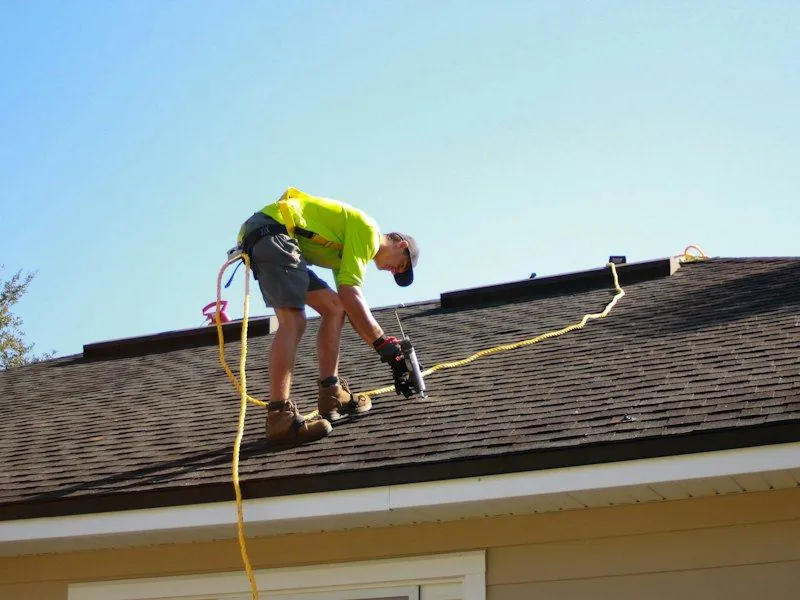
A new roof on new work: an addition, a dormer, a converted loft or a building going up from scratch.
New work is the one case where the roof can be got right rather than merely made watertight. Ventilation paths, ice barrier coverage and the tie-in to the existing structure are all cheap to do properly while the framing is exposed and expensive to correct afterwards.
On new work the decisions that cause leaks ten years out are made before the covering is opened. Sequencing with the other trades matters more than the roofing itself.
An addition or a dormer is the one chance to build a roof properly rather than make an existing one watertight. Almost all of it is cheap now and expensive later.
Where new framing meets old, the two will move differently. The junction needs a flashing detail designed for that, not a bead of sealant across the joint.
An addition that blocks the original eave intake starves the whole roof of air. This gets designed while the framing is open or it does not get done at all.
From the eave edge to at least 24 inches inside the interior wall line. On a low addition with a shallow pitch that can mean most of the roof.
Dry-in has to happen before the interior work starts, and any penetration — flue, vent, mechanical — wants to be set before the covering rather than cut through it afterwards.
Drip edge, rake detail and the gutter line are the parts of new work most often left to the end and rushed. They are also where wind gets under a covering first.
Tying new work into an older building is where most of the risk sits. The existing structure rarely matches the drawing, and the junction detail usually has to be resolved on site.
The residential streets around the park carry a mix of substantial older houses and dense two- and three-family blocks, depending on which side of it you are on.
Reference point: the Olmsted-designed park on the city's northern edge, best known for its cherry blossoms.
Heavy mature tree cover is the distinguishing factor. Constant leaf load fills valleys and gutters, and a new covering installed without correcting the drainage will fail early at exactly the same points the old one did.
Replacement near the park is worth timing outside the heaviest leaf fall, simply because a clean deck is easier to inspect and a clean valley is easier to detail.
The residential streets around the park carry a mix of substantial older houses and dense two- and three-family blocks, depending on which side of it you are on.
All areas coveredNewark sits in a humid subtropical shading into humid continental (Koppen Cfa/Dfa) zone with a full freeze-thaw winter — the combination hardest on flashings, fixings and mortar.
Water that gets into a lap, a joint or a hairline crack and then freezes expands. Northern New Jersey cycles through that repeatedly each winter, so small defects do not stay small.
Melt moves slowly under a snow layer and refreezes at the cold eave, backing water up under the covering where pitch does not help. That is what the ice barrier exists for.
Rain coming in sideways gets under laps that shed vertical rain perfectly well, which is why edge and flashing detail matters more than the covering specification.
The same job in the areas next door, and the other work we take on in this one.
General guidance about how these buildings are re-roofed, not a survey of any particular property.
Everything that causes leaks in ten years is decided before the covering is opened: the tie-in to the existing structure, the ventilation path and the ice barrier coverage. All are cheap while the framing is exposed and expensive afterwards.
Because the era does. On mixed streets two addresses a block apart can have different deck construction, different layer counts and different ventilation, and those decide the price far more than the roof area does.
Replacing more than a quarter of a roof surface within any twelve months requires a construction permit under the New Jersey Uniform Construction Code. A full replacement is over that threshold, so yes — and the work is inspected at stages.
Tell us what the building is and roughly how old the roof is. That is usually enough to say what the job involves before anyone goes up.