Serving Newark and Essex, Hudson & Union County Replacement and installation only
(973) 788-8324
NNewark RidgeRoofing
Storm Damage Roof Replacement

Storm Damage Roof Replacement in University Heights

Replacement after a specific weather event, documented while the evidence is still on the roof.

01 University Heights

Document the cause before it disappears.

Storm damage and ordinary wear are treated very differently, and the difference usually has to be demonstrated rather than asserted. What establishes it is a dated event paired with damage consistent with that event — lifted courses, displaced ridge, torn edge metal — not simply a leak noticed afterwards.

University Heights

Storm Damage Roof Replacement, and what it actually involves

Two claims on the same street after the same storm can be judged very differently, and the difference is usually how well the damage was recorded in the first day or two.

  • Stripped to the deck, not re-covered over the old roof
  • Deck inspected once exposed, with a stated allowance
  • Scoped against the NJ Uniform Construction Code
  • Newark and the surrounding Essex, Hudson and Union towns

(973) 788-8324
A storm front building over rooftops
Replacement work
01 After a storm

Document the cause while it is still on the roof

Storm damage and ordinary wear are treated very differently, and the difference has to be shown rather than claimed.

01

Fix the damage to a dated event

A claim turns on a specific storm and on what that storm did locally. Tying the damage to a date is what separates sudden loss from gradual deterioration.

02

Photograph before anything is touched

Temporary covering, debris clearing and the next rainfall each remove evidence. Photographs taken first are worth more than any description written later.

03

Record what is missing, not only what is wet

Lifted or displaced courses, torn edge metal, a moved ridge, impact marks. Wind damage is often visible only at the edges, which are the hardest parts to see from the ground.

04

Separate the storm from what preceded it

Storm damage frequently sits on top of a covering already near the end of its life. An honest scope says which part is which rather than attributing everything to the weather.

05

Replace to a specification, not to match

Rebuilding exactly what failed reproduces the failure. Where the original fixing or edge detail was the weak point, the replacement is the moment to correct it.

02 Applied to University Heights

What changes about this job here

On a large roof the wind damage concentrates at the perimeter — edge metal, corners, and the first few feet of membrane. That is where to record, and it is invisible from ground level.

University Heights — large single-span roofs

A mix of institutional buildings, student and staff housing, and older residential blocks that predate the campuses around them.

Reference point: the campuses of Rutgers University-Newark and NJIT.

03 On the ground in University Heights

What gets replaced here, and what makes it awkward

Where the difficulty sits

Institutional roofs and the houses beside them fail on completely different timescales and to different standards. On the institutional side the question is usually the specification and the warranty; on the residential side it is the age of the covering.

Worth knowing locally

Work near a campus is constrained by term dates far more than by weather, and a replacement is usually scheduled around them.

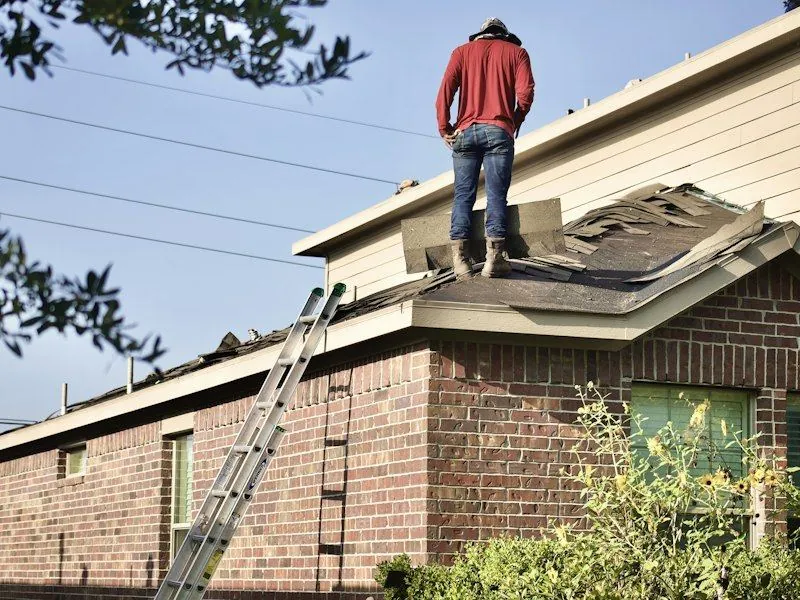
Storm-damaged covering stripped back for inspection
University Heights
Buildings in University Heights

What the roofs are like in University Heights

A mix of institutional buildings, student and staff housing, and older residential blocks that predate the campuses around them.

All areas covered
05 The rules that apply

What New Jersey code requires on a replacement

Worth knowing before accepting any quote, because a scope that ignores these is a scope that will change later.

One code, statewide

New Jersey adopts a single Uniform Construction Code and municipalities may not set lesser or greater technical requirements. A correct specification in Newark is correct in Kearny.

Two layers, then tear off

No more than two applications of covering may remain on a structure. A third means a full strip, whatever the quote assumed.

The 25% permit threshold

Replacing more than a quarter of a roof surface within any twelve months requires a construction permit. Splitting one job in two inside that window does not avoid it.

Ice barrier at the eaves

Required in this design zone, running from the eave edge to at least 24 inches inside the interior wall line.

Who enforces it here

In Newark the code is enforced by the city's Department of Engineering, Division of Construction Code Enforcement, which is where permits for qualifying work are issued.

Inspection before cover-up

Where a permit applies, the work is inspected at stages. A programme that ignores inspection windows is a programme that will slip.

Nearby & related

Storm Damage work close to University Heights

The same job in the areas next door, and the other work we take on in this one.

See every area we do storm damage roof replacement in across Newark →

Questions

Common questions

General guidance about how these buildings are re-roofed, not a survey of any particular property.

Does it matter how quickly storm damage is reported?

Yes, because the evidence degrades within days. Temporary covering, debris clearing and the next rainfall each remove part of it. Photographs taken before any of that are worth more than a description written weeks later.

Does the building have to close during the work?

No. Large single-span roofs are phased so that whatever is stripped can be made watertight the same day, and the space underneath stays in use throughout.

Will this need a permit?

Replacing more than a quarter of a roof surface within any twelve months requires a construction permit under the New Jersey Uniform Construction Code. A full replacement is over that threshold, so yes — and the work is inspected at stages.

Thinking about a replacement in University Heights?

Tell us what the building is and roughly how old the roof is. That is usually enough to say what the job involves before anyone goes up.

Call (973) 788-8324