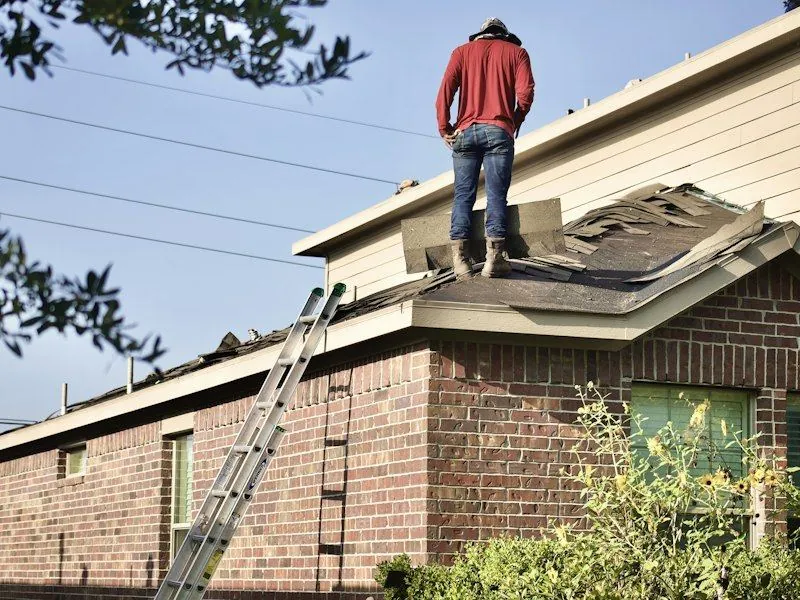
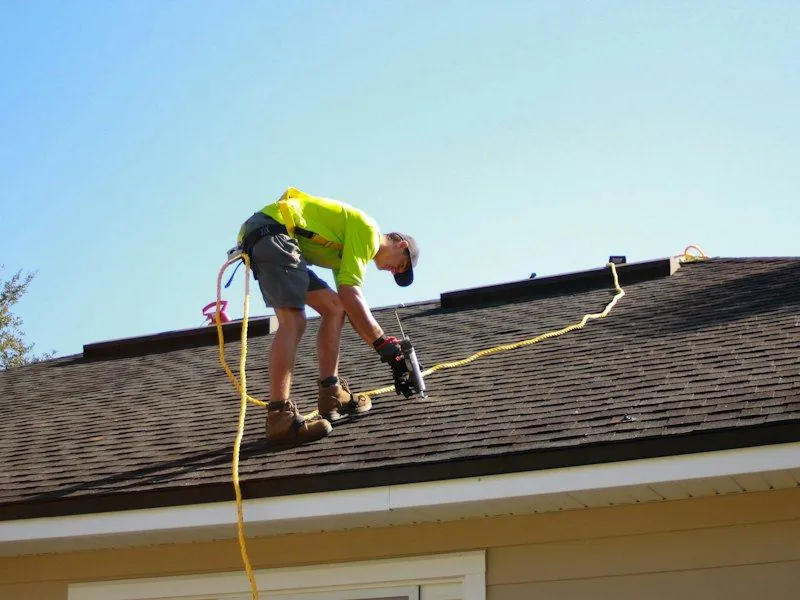
A full tear-off and a new roof system, specified for the building it is going on rather than to whatever is cheapest on the van.
The part of a replacement that decides how long it lasts happens in the hour after the old covering comes off, when the deck is visible for the first time in decades. Everything before that is logistics and everything after it is installation; that hour is the only chance to find out what is actually being roofed over.
A replacement is not a covering swap. It is a system -- deck, underlayment, ice barrier, flashings, ventilation and covering -- and the covering is the part that matters least.
Everything before that hour is logistics. Everything after it is installation. That hour is the only time anyone sees what is actually being roofed over.
How many layers, what the covering is, and what the building has had done to it. The layer count alone can decide whether a tear-off is optional or mandatory.
Not to the previous covering. A new system laid over an old one inherits every defect underneath it and hides the evidence of them at the same time.
Soft, delaminated or rotted sheathing is replaced now, while it is reachable. This is the single most common reason an honest quote carries a stated allowance rather than one flat number.
Ice barrier at the eaves, underlayment, valley and penetration flashings, edge metal, then the covering. Most premature failures are a flashing detail, not a shingle.
Intake at the eaves and exhaust at the ridge, balanced. A sealed roof deck with no path for air cooks the covering from underneath and shortens its life regardless of what it cost.
A detached house gives the cleanest replacement available: the whole roof can be reached from its own ground, waste can be staged on site, and once the covering is off the entire deck is visible at once rather than in sections.
Moderate density on under three square miles, with a stock weighted to single-family and two-family houses on regular lots.
Reference point: the township on Newark's southern border, in Union County.
Regular lots and simpler roof shapes make this the most predictable replacement work in the service area. The variables are the age of the covering and what the deck looks like underneath it.
Simpler roofs are easier to quote accurately, which usually means fewer changes once the tear-off starts.
Moderate density on under three square miles, with a stock weighted to single-family and two-family houses on regular lots.
All areas coveredWorth knowing before accepting any quote, because a scope that ignores these is a scope that will change later.
New Jersey adopts a single Uniform Construction Code and municipalities may not set lesser or greater technical requirements. A correct specification in Newark is correct in Kearny.
No more than two applications of covering may remain on a structure. A third means a full strip, whatever the quote assumed.
Replacing more than a quarter of a roof surface within any twelve months requires a construction permit. Splitting one job in two inside that window does not avoid it.
Required in this design zone, running from the eave edge to at least 24 inches inside the interior wall line.
In Newark the code is enforced by the city's Department of Engineering, Division of Construction Code Enforcement, which is where permits for qualifying work are issued.
Where a permit applies, the work is inspected at stages. A programme that ignores inspection windows is a programme that will slip.
The same job in the areas next door, and the other work we take on in this one.
General guidance about how these buildings are re-roofed, not a survey of any particular property.
Because a covering laid over an old one inherits every defect beneath it and hides the evidence at the same time. It also uses up the second of the two layers New Jersey permits, so the next replacement is a mandatory strip regardless.
Largely, yes. On a detached building the eaves, rakes and valleys can all be reached and the layer count checked, which is why quotes on detached houses hold better than quotes on shared roofs.
Replacing more than a quarter of a roof surface within any twelve months requires a construction permit under the New Jersey Uniform Construction Code. A full replacement is over that threshold, so yes — and the work is inspected at stages.
Tell us what the building is and roughly how old the roof is. That is usually enough to say what the job involves before anyone goes up.