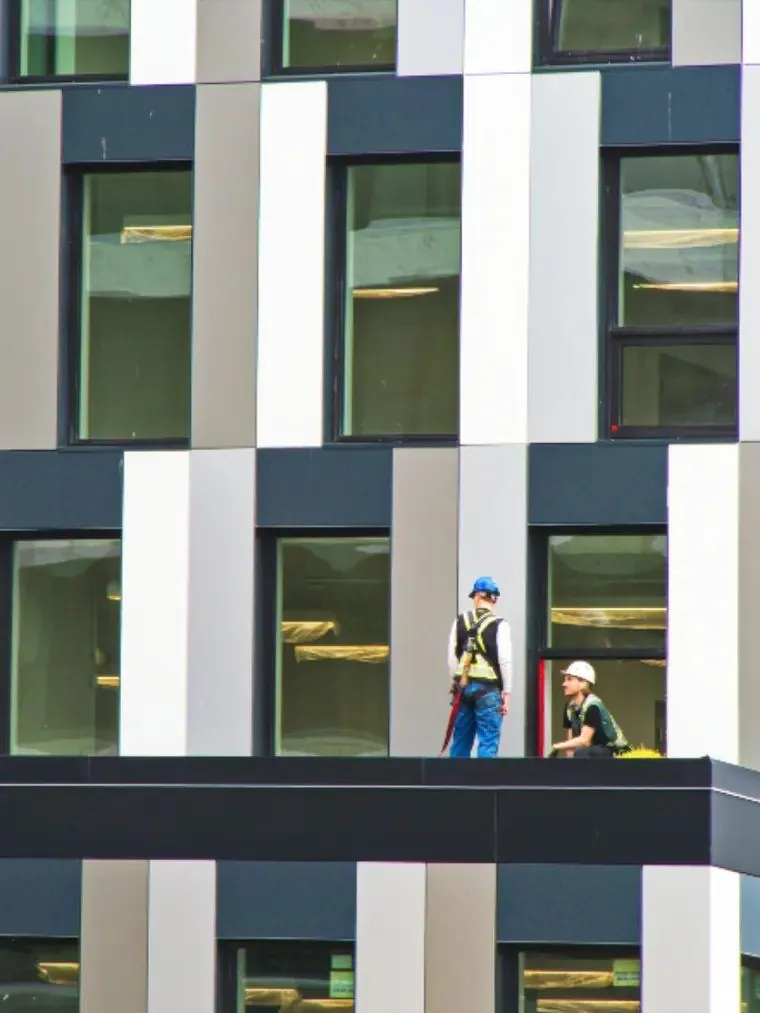
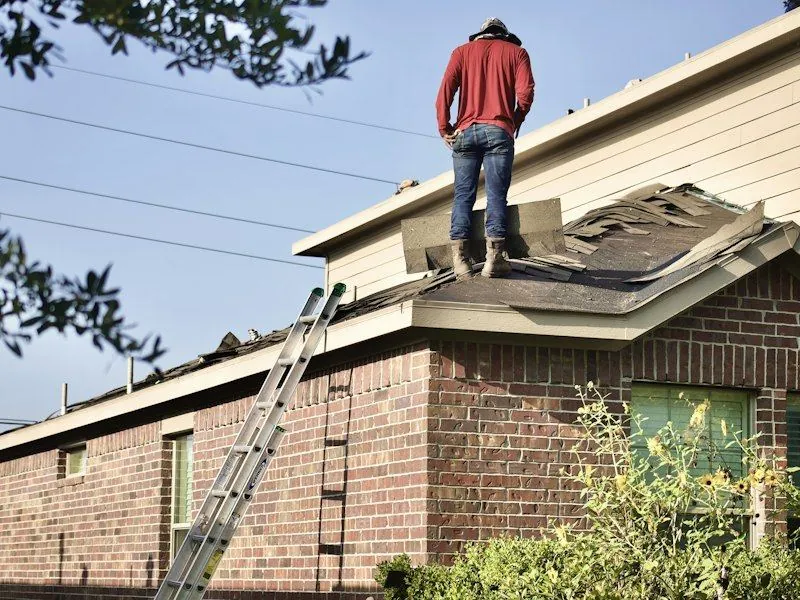
Low-slope systems replaced with the falls corrected, not just the membrane renewed over the same standing water.
Re-covering a flat roof without correcting the fall reproduces the failure on a new membrane. If water stood on the old system it will stand on the new one, in the same places, and the seams under it will be tested continuously rather than occasionally.
On a low-slope roof the specification argument is usually about the membrane, and the thing that decides the outcome is usually the drainage.
A flat roof that ponded before will pond again under a new membrane, in the same places, unless something about the drainage changes.
Water still standing forty-eight hours after rain means the fall, the drains or the deck have moved. A new membrane laid over that is being tested continuously instead of occasionally.
A blocked or undersized outlet turns the roof into a shallow tank. Replacement is the only realistic opportunity to correct outlet positions, so it should be taken.
Where the structural deck cannot be re-pitched, tapered insulation builds the fall into the build-up. It is the difference between a roof that drains and one that merely has a membrane.
Pipes, vents, mechanical curbs and fixings each get flashed individually. On a large roof these outnumber every other failure point put together.
Saturated boards under an old membrane stay saturated once a new one is over them. If the survey shows wet insulation it comes out, or the new roof is compromised on day one.
The membrane turning up a wall, and the bar that holds it there, take the stress. The field of the membrane rarely fails first.
Flat areas on a detached house are usually an addition or a porch roof rather than the whole building, so the question is normally the tie-in to the pitched roof above rather than the field of the membrane.
Moderate density on under three square miles, with a stock weighted to single-family and two-family houses on regular lots.
Reference point: the township on Newark's southern border, in Union County.
Regular lots and simpler roof shapes make this the most predictable replacement work in the service area. The variables are the age of the covering and what the deck looks like underneath it.
Simpler roofs are easier to quote accurately, which usually means fewer changes once the tear-off starts.
Moderate density on under three square miles, with a stock weighted to single-family and two-family houses on regular lots.
All areas coveredWorth knowing before accepting any quote, because a scope that ignores these is a scope that will change later.
New Jersey adopts a single Uniform Construction Code and municipalities may not set lesser or greater technical requirements. A correct specification in Newark is correct in Kearny.
No more than two applications of covering may remain on a structure. A third means a full strip, whatever the quote assumed.
Replacing more than a quarter of a roof surface within any twelve months requires a construction permit. Splitting one job in two inside that window does not avoid it.
Required in this design zone, running from the eave edge to at least 24 inches inside the interior wall line.
In Newark the code is enforced by the city's Department of Engineering, Division of Construction Code Enforcement, which is where permits for qualifying work are issued.
Where a permit applies, the work is inspected at stages. A programme that ignores inspection windows is a programme that will slip.
The same job in the areas next door, and the other work we take on in this one.
See every area we do flat roof replacement in across Newark →
General guidance about how these buildings are re-roofed, not a survey of any particular property.
Only if the water drains. A membrane laid over a fall that already ponds will pond in the same places, and the seams under standing water are tested continuously rather than occasionally. Correcting the fall is usually the actual job.
Largely, yes. On a detached building the eaves, rakes and valleys can all be reached and the layer count checked, which is why quotes on detached houses hold better than quotes on shared roofs.
Replacing more than a quarter of a roof surface within any twelve months requires a construction permit under the New Jersey Uniform Construction Code. A full replacement is over that threshold, so yes — and the work is inspected at stages.
Tell us what the building is and roughly how old the roof is. That is usually enough to say what the job involves before anyone goes up.